
Every Empty Seat Is Costing You: How the Right Recruitment Services Stop Open Roles From Slowing Your Growth
Open roles don’t just sit empty — every day one stays vacant quietly taxes momentum, slows delivery and stretches your best people thinner. Fixing it starts with understanding what the vacancy actually costs.
You approved the headcount. You wrote the job description. You posted it everywhere. Weeks later, your inbox is full of resumes, but none of them are right.
Meanwhile, your team is stretched thin, deadlines are slipping, and your best people are quietly absorbing the work of a role that doesn’t exist yet.
If that sounds familiar, you’re not alone. For many U.S. companies, hiring has become the bottleneck that holds back everything else. The good news is that it’s fixable, and the fix starts with understanding what an open role actually costs you.
The hidden price tag of an unfilled role
Most leaders track the cost of hiring: job board fees, agency fees, interview hours. Far fewer track the cost of vacancy, what you lose for every day a critical seat stays empty.
A simple starting formula is:
Annual base salary ÷ 260 working days × days vacant
Take a $120,000 role that stays open for 60 days. That’s about $27,700 in salary-equivalent capacity, work that isn’t getting done. And that number doesn’t include missed revenue, delayed product launches, or the burnout of overloaded teammates.
HireVista’s cost of vacancy calculator uses this same transparent formula, so you can plug in your own numbers. It deliberately excludes revenue assumptions, so you get a conservative baseline you can defend in a budget meeting.
The takeaway is simple: slow hiring is never free. It just doesn’t show up on an invoice.
Why hiring takes so long (and why more resumes don’t help)?
Most hiring delays come down to the same few problems:
- Vague role definitions. A generic job title hides what the person will actually do, so sourcing starts from guesswork.
- Resume dumps. Hiring managers get stacks of unfiltered candidates and end up doing the screening themselves.
- Keyword matching. Candidates list every tool under the sun, but listing a tool isn’t the same as having used it to ship real work.
- Stretched internal teams. Recruiters juggling too many requisitions can’t search proactively, so they wait for applicants to arrive.
- The wrong hiring model. Using a one-off search for an ongoing need (or the reverse) wastes time and money.
None of these are solved by posting the job in more places. They’re solved by a better process.
What good recruitment services actually look like?
Not all recruitment services are equal. The best partners don’t just forward resumes. They change how the search is run. Look for a partner that does the following.
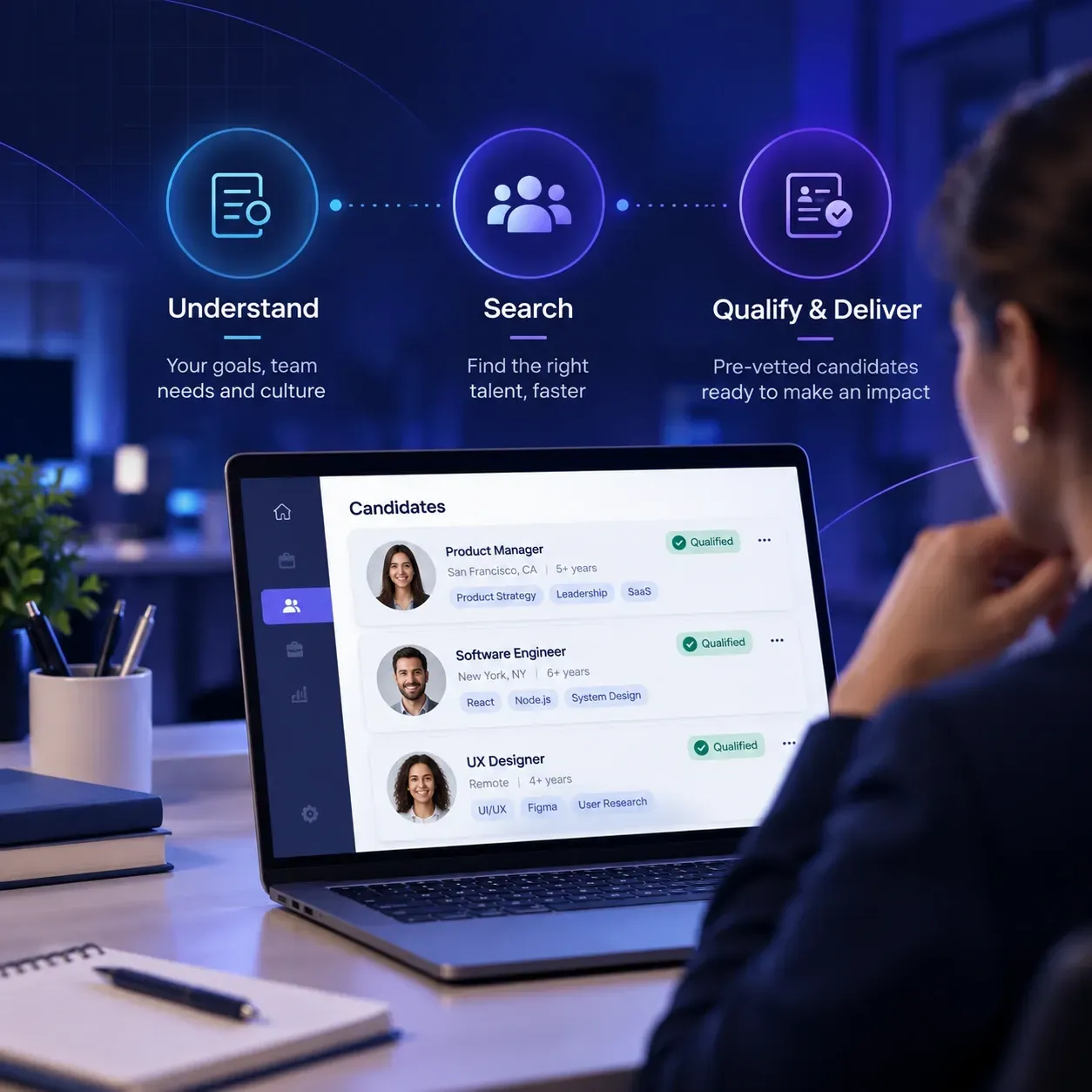
1. Starts with the work, not the job title
Great recruiting begins by defining what success looks like before sourcing starts. That means understanding your goals, team culture, must-haves, and trade-offs, then turning them into a practical hiring scorecard. When everyone agrees on the target up front, you avoid weeks of “not quite right” interviews.
2. Searches proactively
The strongest candidates are rarely job-hunting. A good partner builds focused search lanes, reaches out directly, and qualifies people before they reach your hiring team.
3. Delivers a shortlist that explains itself
A shortlist should tell you why each person fits, not leave your hiring manager to re-screen a pile of resumes. Clear reasoning for every candidate cuts interview time and improves decision quality.
4. Learns from every interview
Feedback shouldn’t disappear into a void. The best partners use your interview notes to sharpen the next round of searching, so quality improves with each cycle.
Match the hiring model to the hiring need
One reason hiring feels harder than it should is that companies use a single approach for every situation. In reality, different needs call for different models:
- Direct hire recruitment suits high-impact permanent roles where quality and long-term fit matter most.
- Recruitment Process Outsourcing (RPO) works when you have multi-role or recurring demand and need embedded recruiting capacity without growing your internal team. If you’re unsure how it compares to a traditional agency, our RPO services page breaks the model down.
- Contract staffing and IT staff augmentation let you add specialized talent quickly and scale up or down as projects change.
- Startup recruitment supports focused searches for fast-moving teams that can’t afford a long hiring cycle.
Choosing the right model up front can save weeks of wasted effort.
Why technical hiring needs extra care?
Hiring a software developer, data engineer, or DevOps specialist is a different challenge from filling a general role. Stack, seniority, environment, and ownership all matter, and a strong-looking resume can hide a poor fit.
Effective technical recruitment looks beyond keywords and evaluates:
- Stack and role depth: evidence of doing the work, not just listing tools
- Environment fit: startup, scale-up, enterprise, product, or services context
- Collaboration and ownership: how a person communicates, decides, and delivers with a team
If you’re hiring engineers right now, our software developer search walks through calibrating the stack and screening for evidence instead of buzzwords. You can also explore specialized searches for AI engineers, data engineers, and DevOps engineers.
A quick checklist before you hire your next role
Before you open the next requisition, ask yourself:
- Have we defined what success looks like in the first 6 to 12 months?
- Do we know the real must-haves versus the nice-to-haves?
- Have we calculated what this vacancy costs per day?
- Is a direct hire, RPO, or contract model the right fit for this need?
- Does our partner screen for context, or just keywords?
- Will we receive a shortlist with clear reasoning, or a resume dump?
If you can’t answer most of these confidently, a structured recruitment partner can close the gap faster than another round of job postings.
Final thoughts: hiring shouldn’t slow you down
Growth depends on people. When the right talent shows up quickly, projects move, teams stay energized, and opportunities don’t pass you by. When it doesn’t, every empty seat quietly taxes your momentum.
The solution isn’t more applicants. It’s a clearer process, the right hiring model, and a partner who understands your context.
Ready to stop losing time to open roles? Request talent from HireVista and tell us the role, timeline, and what’s making the search difficult. We’ll recommend the right recruiting model to get you from requirement to qualified talent.
Frequently asked questions.
What do recruitment services include?
Recruitment services typically include role calibration, candidate sourcing, screening, shortlisting, and interview coordination. Depending on the model, they can cover direct hire, RPO, contract staffing, or IT staff augmentation.
When should a company use RPO instead of a recruitment agency?
RPO fits companies with ongoing or multi-role hiring demand that want embedded recruiting capacity. A traditional agency often suits one-off searches.
How do I calculate the cost of an open position?
Divide the annual base salary by 260 working days, then multiply by the number of days the role has been vacant. This gives a conservative salary-equivalent baseline.